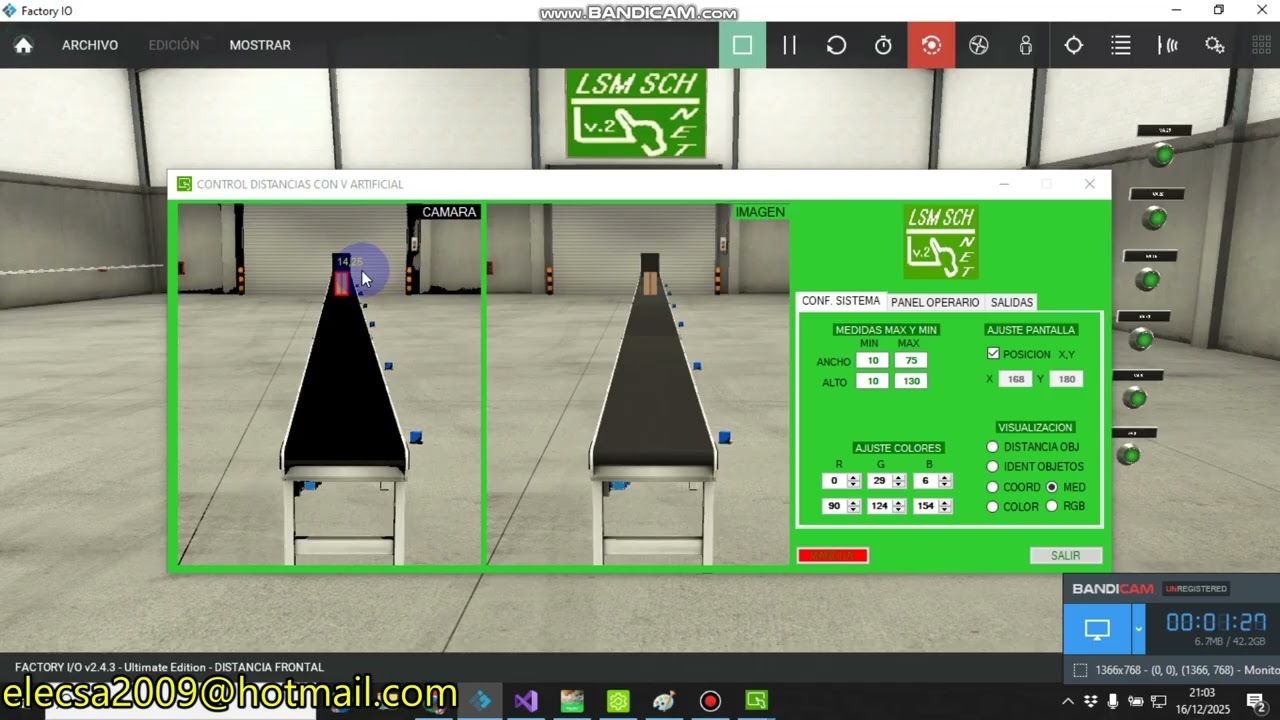
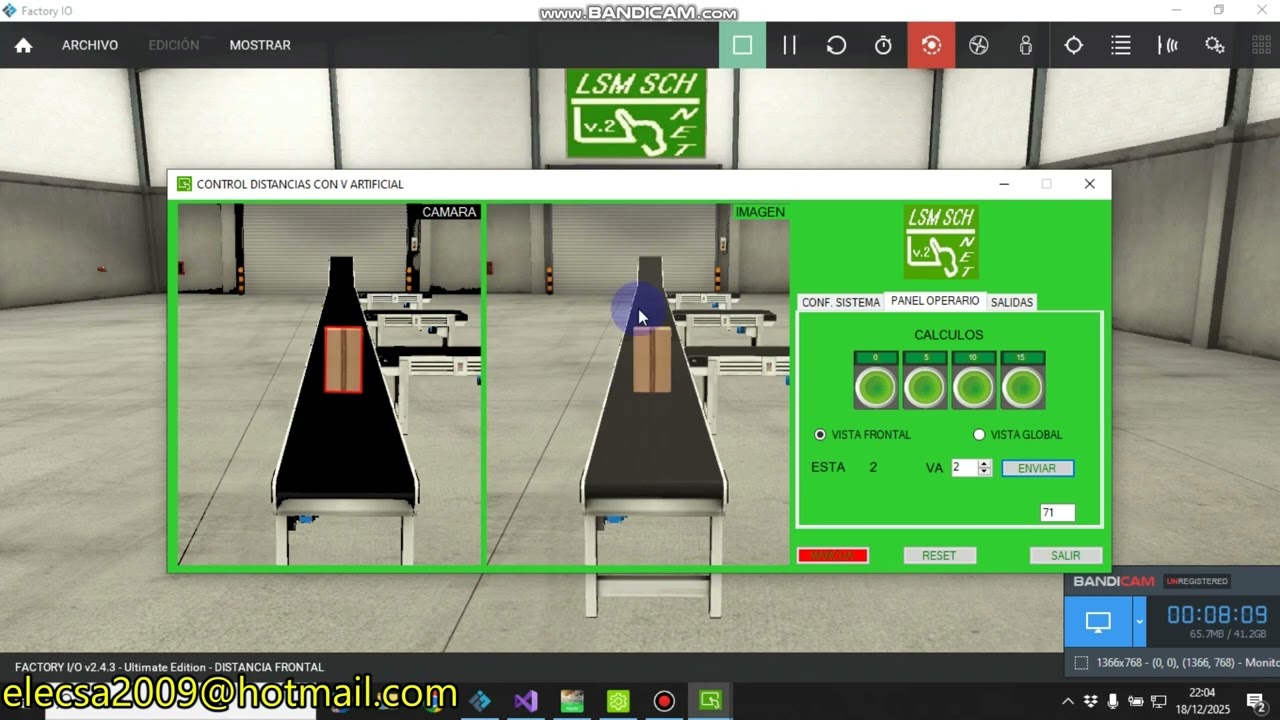
We continue calculating distances, in this case horizontal, although in this case they are not real distances, since real distances cannot be calculated in Factory IO, what can be done is to try to make a triangulation function that returns the distance to which the box is located calculated with the data of the image.
This project is geared more towards teachers, because you don’t always have everything you need. Imagine a client needs to detect objects by horizontal distance for some reason. How would you do the triangulation? What references or data obtained from the image would be best for this calculation? Furthermore, these projects done with FactoryIO demonstrate the simulator’s capabilities and what it can teach. Of course, you have to do what needs to be done…
Finally, the length was reduced from 25 to 15 meters because the pixels in the last two sections weren’t sufficient. In fact, we had to perform some balancing acts for the third section, adjusting the width as well as the height.
This is a truly educational exercise, because even though it might not seem like it, you learn a lot from these kinds of challenges. Of course, it’s all possible thanks to Factory IO.
That’s right, but keep the following in mind, I’m telling you this from experience, specifically with this project:
First of all, the measurements aren’t real; they’re imaginary.
Second, the height of the box, in the attached example, is the same from 10 meters to 15 meters, but the width varies. However, starting at 20 “IMAGINARY” meters, the box is practically the same, which is why it can’t be used any further, and other calculations have to be done.
In the case of the top view, if it’s 600 x 600 REAL pixels, and therefore, with the appropriate scale, the application is perfectly viable.
Does this mean that the attached horizontal application isn’t valid? Not at all. It can be useful if circumstances allow, even though the values are imaginary.
On the other hand, that simple comment you made demonstrates the level that Factory IO has if used to its full potential, but unfortunately, that’s not the case.